Choosing a Vehicle for Private Aviation
Matching vehicle class to a private aviation transfer — luggage first, passengers second, prestige last.
Key points
- Luggage decides more bookings than passenger count.
- Journey length argues for the larger saloon.
- Rural and estate approaches favour the SUV.
- Six passengers means an MPV, without exception.
Start with luggage
Vehicle choice for a private aviation transfer is a capacity problem before it is a preference. Two passengers with four large cases need an MPV or an SUV, not an executive saloon. Counting the cases honestly at the booking stage settles the question.
If several people are travelling separately to the same destination, quoting the a private aviation transfer as one coordinated movement usually works better than booking a series of unconnected cars.
Then passengers
Three passengers fit a saloon comfortably for a short run and less comfortably for a long one. Four or more is an MPV. Two passengers who want genuine space to work or rest are the classic case for the luxury or ultra-luxury saloon.
The middle rear seat exists but is rarely the seat anyone wants on a two-hour journey, and honest planning treats a saloon as a two-passenger vehicle for long distances.
Journey length
Under half an hour, the difference between classes is mostly cosmetic. Over ninety minutes it is not: rear legroom, seat adjustment and ride quality become the difference between arriving ready and arriving stiff. A private aviation transfer covering FBO and executive handling transfers coordinated with the flight operator over distance argues for the larger saloon.
Rest is a legitimate use of a a private aviation transfer. Passengers arriving from a long flight frequently sleep, and chauffeurs adjust route smoothness and cabin temperature accordingly.
Terrain and access
Country lanes, gravel driveways, estate approaches and winter conditions favour the SUV. Tight urban car parks with height barriers favour the saloon. Both considerations are checked against the actual addresses rather than assumed.
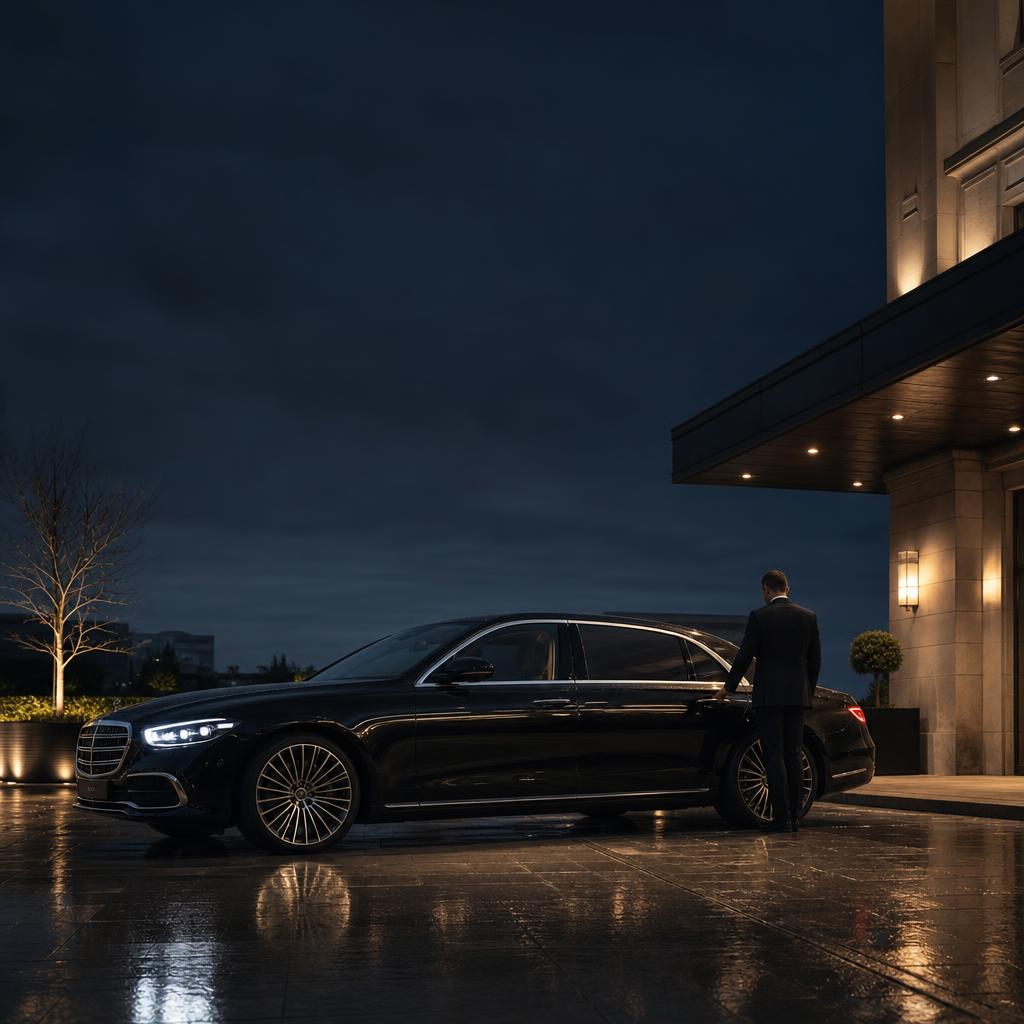
Presentation is part of the service. For a a private aviation transfer the chauffeur arrives in business dress, the cabin is prepared with still water, and phone charging is available without needing to ask.
Electric options
An electric flagship is available where the itinerary suits it, and it is a genuine option for organisations reporting on travel emissions. Range and charging are assessed against the specific route rather than promised in general.
Judged purely on distance, a a private aviation transfer costs more than a metered alternative. Judged on recovered working time, guaranteed capacity and a fixed price agreed before travel, the comparison usually looks different.
How the class is confirmed
Your quotation names a vehicle class, and a preferred model is recorded where you have one. Specific models remain subject to availability at the time of travel; the class does not.
Where a a private aviation transfer crosses regions, the itinerary is planned as one continuous movement rather than a series of handovers, so luggage and passengers stay with the same vehicle.
Ready to arrange this journey?
Send us the details and we will confirm a vehicle and a fixed price. Every field on the quote form goes straight to our client service desk on WhatsApp.
Get a QuoteUseful links
Frequently asked questions
Related reading
All articlesHow Private Aviation Work, Step by Step
From enquiry to completion: exactly what happens on a private aviation transfer booking, stage by stage.
Service GuidesPrivate Aviation: A Booking Checklist
Everything worth confirming before a private aviation transfer is booked, in the order it matters.
Service GuidesCommon Mistakes When Booking Private Aviation
The handful of avoidable errors that account for most problems on a private aviation transfer.
Service GuidesPrivate Aviation: Etiquette and What to Expect
Seating, conversation, luggage handling and gratuities — the unwritten rules of a private aviation transfer, written down.